As one of the finest walled gardens in Hampshire, Houghton Lodge’s kitchen garden stands as a testament to centuries of horticultural tradition. As the seasons unfold within these protective walls, they reveal not just beautiful plants but living history, stories told through ancient varieties, and time-honored growing techniques that connect us to generations past.
The Architectural Marvel of Chalk Cob Walls
What distinguishes our walled garden from other historic house gardens across England is the remarkable chalk cob wall that encloses it. Considered the finest and most complete produce garden wall made of chalk cob, still fulfilling its original purpose, these structures represent a vanishing architectural heritage that once defined productive gardens throughout Hampshire.
These walls weren’t merely boundaries but sophisticated growing technologies. Built exceptionally high and topped with loose tiles to discourage intruders, the walls feature a flint base that serves as a natural damp course. The walls themselves are crafted from a mixture of chalk and straw ‘puddled’ by oxen or horses, which were constructed layer by layer, each allowed to dry before the next was added.
Nature’s Greenhouse Effect
The genius of these chalk cob walls lies in their thermal properties. Acting as natural heat sinks, they absorb the sun’s warmth during daylight hours and release it gradually throughout the night. This creates a microclimate that extends the growing season and enables us to cultivate fruit varieties that might otherwise struggle in the Hampshire climate. The walls continue to serve their original purpose centuries later, nurturing our magnificent collection of espaliered fruit trees as well as a bountiful kiwi plant.
A Living Museum of Heritage Fruits
While many walled gardens in Hampshire have been restored primarily for ornamental purposes, our heritage orchard is one of the garden’s most significant contributions to preserving horticultural biodiversity.
The walled garden proudly houses 45 apple trees representing 30 different varieties, primarily grown as espaliers along a north-south avenue through the center of our one-acre space. These trees, many now supported by rustic crutches, include varieties that span centuries of pomological history:
- Ribston Pippin (1707) – A parent of the famous Cox’s Orange Pippin
- Orleans Reinette (1776) – Known for its complex, nutty flavor
- D’Arcy Spice (1785) – Celebrated for its distinctive spicy notes
- Peasgood Nonsuch (1853) – Prized for its enormous cooking apples
- Lane’s Prince Albert (1857) – A Victorian cooking staple
- Victoria (1899) – Not to be confused with the plum of the same name
These historic varieties often contain significantly higher vitamin content than modern commercial varieties. Each has a distinctive flavor profile that would have been familiar to previous generations but is now virtually unknown to modern palates. When visitors taste these apples during our harvest events, they’re experiencing flavors that have largely disappeared from our food culture.
Record-Breaking Pears
The eastern and western walls of our kitchen garden support ten varieties of heritage pear trees, including some remarkably old cultivars:
- Catillac (1665) – A cooking pear with extraordinary keeping qualities
- Louise Bonne of Jersey (1780) – Once the most popular dessert pear in England
- Pitmaston Duchess (1841) – Known for its exceptional size
- Doyenne de Comice (1849) – Still considered by many to be the finest flavored pear
- Laxton’s Superb (1920) – Developed by the famous Laxton Brothers nursery
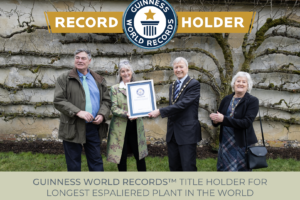
Pride of place goes to our champion Beurre Diel pear tree, which in 2019 was crowned by The Tree Register as the widest espaliered pear tree in Britain (16.44m/53.93′) and verified by GUINNESS WORLD RECORDS® as the longest espaliered plant in the world. Propagated in the early 1800s in Belgium and named after German pomologist Dr. Augustus Diel, this magnificent specimen has been thriving against our chalk cob wall for at least a century, producing delicious, juicy dessert pears each autumn.
Restoration and Renovation: Preserving Living Heritage
Unlike static museum exhibits, historic house gardens require constant care and renewal. In 2024, we completed a decade-long restoration of our Heritage Orchard and have now moved into the renovation phase, a meticulous process that honors traditional techniques while ensuring these living treasures continue to thrive.
Traditional Espalier Training
One of the most fascinating aspects of maintaining our walled garden is the traditional espalier training techniques we employ. When side branches are lost through age or damage, we select young shoots during the growing season and, on warm days when they remain pliable, gently maneuver them into horizontal positions. These are secured with flints collected from our farm fields and tied with biodegradable jute twine.
This process requires extraordinary patience—it can take up to nine years for a young shoot to develop into a proper branch. This long-term perspective connects our gardening team to a tradition that transcends modern notions of instant results, reminding us that the best walled gardens in Hampshire have always been multi-generational projects.
Beyond Apples and Pears
While fruit trees dominate the productive aspects of our walled garden, we’ve developed several specialised collections that enhance the experience of visiting one of the most enchanting historic house gardens in the region.
A Passion for Peonies
Our magnificent peony walk, underplanted with muscari that creates a stunning blue and purple display in early spring, contains a significant horticultural treasure. Planted in the early 1980s to replace an iris walk, these peonies were sourced from the famous Kelways nursery. Kelways has faced liquidation several times, and some of their special varieties have been lost to cultivation, except for specimens thriving here at Houghton Lodge. This makes our collection not just beautiful but botanically significant.
The Quadrant Herb Garden
Divided into four themed sections: pot pourri & perfumery, natural dye, herbal tea, and medicinal herbs, our herb garden connects visitors to the practical plant knowledge that would have been essential to households in previous centuries. The beds include carefully selected roses that would have been found in apothecary gardens of ancient times, including Gallica, Damask, and China varieties. The double buff/pink flowers of the rose ‘Ghislaine du Feligonde’ cascade over rose arches, adding height and fragrance to this practical garden space.
Specialist Collections
Recent additions to the walled garden include:
- A dedicated hosta bed featuring varieties from the enormous ‘Abiqua Drinking Gourd’ to the diminutive ‘Blue Mouse Ears’
- Two iris beds containing bearded varieties from miniature dwarf to tall specimens, creating a stunning display against the majestic cob wall
- Extended cut flower beds providing vibrant color from July onwards with gladioli, scabious, cosmos, salvia, zinnias, and antirrhinums
- Traditional vegetable bed designed to resemble a garden allotment
Sharing the Harvest
The bounty from our walled garden in Hampshire doesn’t go to waste. We press our heritage apples to create distinctive apple juice sold in our Tea Room and have produced ‘Churchwarden’s Tipple’—a special cross between apple brandy and sweet wine. Visitors are encouraged to “scrump” (pick) fruit during their visits, continuing the age-old tradition of gardens as places of both beauty and sustenance.
Preserving Living History
What makes Houghton Lodge’s walled garden truly special among walled gardens in Hampshire is that it remains a working, productive garden rather than simply an ornamental space.
By maintaining these traditions and preserving rare varieties, we’re not just conserving plants but safeguarding cultural heritage.
Whether you’re a gardening enthusiast, history buff, or simply seeking a peaceful retreat, our walled garden offers a living connection to the rich tapestry of Hampshire’s horticultural past.