There are historic houses you visit because you feel you ought to and then there are places that catch you off guard and you wonder how you’ve not found them sooner.
Houghton Lodge is the historic house in Hampshire that will make you feel that.
Set above the tranquil waters of the River Test in the heart of the Test Valley, just five minutes from Stockbridge, Houghton Lodge is a hidden gem designed to make the rest of the world feel far away.
Lawns sweep down towards one of the most celebrated chalk streams in England, whilst ancient trees frame views across the water meadows and at the centre of it all, almost impossibly picturesque, stands the house itself.
Visitors have called it ‘a little piece of heaven.’ Historic Houses Association describes it as ‘the jewel of the Test Valley’ which feels very appropriate as you stand on the terrace looking across the views of the River Test.

What is a Cottage Orné?
Most visitors arrive at Houghton Lodge without knowing what a Cottage Orné is and then leave with a new favourite piece of architectural history.
The style was a brief, beautiful experiment of picturesque Gothic architecture that flourished for approximately 25 years from 1790. It was a deliberate reaction against the formal grandeur of Georgian design, in favour of something more romantic, more intimate, more rooted in the landscape it sat within. The movement produced some extraordinary buildings. It also produced very few that survived, which is precisely what makes Houghton Lodge so significant.
Built in 1793 by the Bernards and designed by John Plaw ( a disciple of Nash, who went on to design the Brighton Pavilion) Houghton Lodge is today recognised as the finest and earliest surviving example of a Cottage Orné in England. It is Grade II* listed, one of only twelve buildings in that category in the whole of Hampshire.
What makes it architecturally remarkable is the combination it achieves. The tall honeypot chimneys, decorative tracery woodwork and metalwork are pure Cottage Orné, yet the underlying structure is entirely Georgian – symmetrical on all four sides, measured and disciplined. Houghton Lodge sits precisely at the moment one architectural age gave way to another, and it shows.
It was built of chalk cob to resemble the cottages of the surrounding Hampshire district, and originally thatched but the thatch was eventually replaced with tiles when the walls began to sink under its weight. The softwood frame was a practical necessity: all hardwoods had been requisitioned to build boats for Nelson’s fleet during the Napoleonic wars. Despite the grandeur of the exterior, the house originally had just three bedrooms. Servants’ quarters, kitchen and storerooms occupied the basement, the ground having been built up specifically to create it.
There is a Jane Austen connection, too, that feels almost too perfect. Born at Steventon, not far from here, she may well have known Houghton Lodge because it was built in precisely the style she was writing about. In Sense and Sensibility, written in 1797, Robert Ferrars extols about life in a cottage just like this one, with its promise of comfort and elegance and room enough to dance.
Houghton Lodge House Tours: personal, quirky, genuinely unlike anything else
There are house tours where you view rooms behind a rope and read from a leaflet. Houghton Lodge is not one of them.
Tours here are guided by Daniel or Sophie Busk, the family who live in the house, or by a guide who knows it almost as well. The rooms are intimate because this is a home, and the stories that come with them are told with the warmth and humour of someone sharing their own family history because that is exactly what is happening.
“Daniel conveyed many interesting stories about his home and its previous owners. It is unique, very quirky and full of history. The gardens are also amazing… thanks to all who made the visit so special.” Visitor review
That word keeps surfacing in visitor accounts: quirky. Not as a polite euphemism, but as genuine delight. Houghton Lodge has accumulated 230 years of life, character, and story, and none of it has been smoothed away for the benefit of tourism. You see the rooms as they are, beautiful and personal and full of the kinds of details that make a place feel truly inhabited.
The music room, with its rare Blue John fireplace and Bristol glass mirrors dating to 1793, has appeared in film productions including Wilde and David Copperfield. The dining room is papered in hand-painted silk from China – the decorators who hung it said that it was a harder job than the Queen’s bedroom at Buckingham Palace!
“We felt privileged to have the opportunity to explore. It’s a real family home and garden, quirky and beautiful.” Visitor review

Step outside: 14 acres of Hampshire garden that rewards every season
The gardens at Houghton Lodge are, in their own way, as quietly extraordinary as the house. Fourteen acres of formal and informal planting, unfolding from the chalk cob walls of the walled garden all the way down to the banks of the River Test.
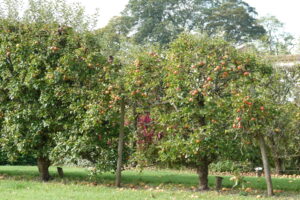
Within the chalk cob walls of the Walled Garden, thirty-two varieties of heritage apple grow in the orchard. Against the west-facing wall grows the world record espaliered pear, the widest of its kind and a living record of the patience that serious horticulture demands. Elsewhere: iris and peony beds, a herb garden divided into medicinal, perfumery, natural dye and herbal tea plantings, an orchid house, sweet peas, and a rose and clematis arbour.
Beyond the walled garden, the 350-foot herbaceous border runs through the seasons with bulbs in spring, tapestry colour through summer, dahlias carrying kaleidoscopic colour into autumn. The Oriental Garden, opened in 2023 to mark the 230th anniversary of the Lodge, brings something different entirely: cherry orchard, acer walk, rose garden, and a Nikko bridge crossing to a Torri arch.
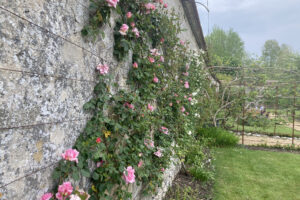
The Peacock Garden has begun a new chapter following the loss of its historic box parterre to box blight and box moth caterpillar. In its place: yew hedging, climbing Rosa ‘Madame Plantier’, an antique white rose dating from 1835, apple-scented and pink-budded, and Clematis ‘Prince George’, all against the backdrop of the Grade II* Cottage Orné. The yew peacocks themselves, which give the garden its name, are being allowed to grow back before being reshaped to their original form.
Historic House Tours
House tours are available to book in advance and include full garden entry. Tours run at selected times throughout the season, with the 11am slot offering the best-value pricing from £25 per person including the gardens.