
The Outer Garden
The Long Border
This magnificent 350’ border provides yearlong beauty and colour bursting with bulbs in the spring, with the horizontal stems of climbing roses coating the cobb walls a dramatic back drop is created. There is a large selection of shrubs, roses and perennials that provide a tapestry of colour through the summer and into the autumn with dahlias, helenium, penstemon, rudbeckia, helianthus, salvia uliginosa and scabious take centre stage against a back drop of rose hips.


The Peacock Garden
From 1900-1970s the peacock garden was a very elaborate rose garden. The ground became rose sick and in 1988 it was removed. My mother-in-law, Anthea Busk, had always craved a box parterre so this is what she planted in its place, and the ‘left over’ box plants were used to create our wonderful puffing dragon. The yew hedge to the east was also added at this time and the wedding border on the other side of the hedge.
Anthea’s box garden flourished from 1988-1995, when box blight arrived in England and decimated our box hedges. On advise from the RHS, a bigger leafed box was planted in its place, which was thought to be resistant to blight.
It looked glorious for a number of years but in 2015, the blight took hold again. We managed to keep it looking good, but in 2025 the blight returned with a vengeance. The box tree caterpillar, the larvae of a moth that feeds on box plants, arrived from East Asia in 2007 and was quite slow at finding us at Houghton. Annoyingly it settled in (who can blame it!) giving us a double problem to deal with: box blight and box tree caterpillar.
…………..It was time for a new chapter for our beloved peacock garden………….
In October 2025 we removed most of the box but kept the box spirals which still seemed healthy and planted osmanthus around them. After much deliberation we chose to replace the bulk of the box hedging with yew (taxus baccata), which is considered one of the best alternatives to box, especially due to its resistance to disease and pests, and for us, yew’s tolerance of shade cast by the surrounding trees. Yew has dense evergreen foliage that provides a similar look to box and it is low maintenance-only needing to be trimmed once a year-which was an important consideration!
To provide height we planted four standard hollies and introduced 4 obelisks. To provide seasonal change around the evergreens we are planting Nepeta Racemosa ‘Snowflake’ (white catmint), Vinca Minor Alba ‘Gertrude Jekyll’ (white periwinkle), Gallium Odoratum (white sweet woodruff).
We have planted Rosa ‘Madame Plantier’, an apple scented white rose with beautiful pink buds and Clematis ‘Prince George’, with its crinkled white flowers, to grow up the obelisks. We will be adding white bulbs-Snowdrops, Leucojum Vernum, Narcissus ‘Thalia’ and Leucojum Aestivum.
The landscaping has been carried out by Charlie G Landscaping Ltd (Andrea, Bear, Medo, Ollie, Sam and Charlie). The yew and osmanthus supplied by Mathias Nurseries.
I hope our 9 peacocks approve of their new view!
We look forward to sharing it with you and watching it grow.
The Wedding Border
A white and green planting scheme, with a line of philadelphus to represent a bridal veil. It is fun selecting wedding themed roses such as ‘wedding day’ & ‘the garland’ and shrubs such as viburnum plicatum ‘mariesii’ (the wedding cake shrub) and exocorda ‘the bride’.


The “Puffing” Dragon
This very special topiary dragon hides away in the darkness of the dogwood, protecting her eggs she can startle our inquisitive visitors who dare venture near!
Created 35 years ago by our son Oliver with his grandmother Anthea Busk, the dragon is a perpetual hit with children of all ages.
The Mercury Border
Surrounding the statue of Mercury is a blue and white cottage garden, with delphinium, phlox, perovskia and geranium under planted with narcissi and muscari. It is resplendent in spring with a cascade of aubretia and alyssum.

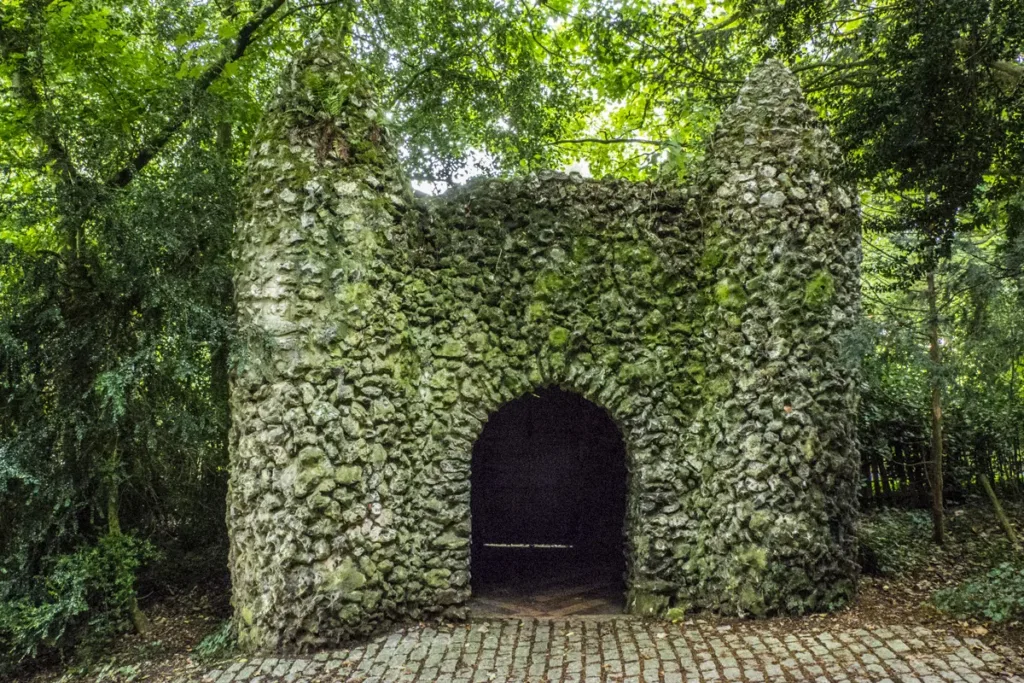
The Grotto
This was most likely built as a job creation scheme during the recession that followed the victory at Waterloo, providing work for the soldiers who had recently returned to the village. This interesting building beloved by both bats and the public, provides an interesting gateway. Originally the road ran directly to the east of Houghton Lodge and below the walled garden. It was diverted to the west, onto higher gravelly/chalky ground, as carriages and wagons kept getting stuck. Now registered for weddings. It is a Grade II listed building.
The Serpentine Walk
From the south side of the entrance forecourt, an arched opening through the yew hedge leads to the start of the early C19 Serpentine Walk which runs south along the line of an C18 road (shown on plans of the area of 1776 and 1827). A gravel path leads through mature trees and shrubs, with views through to the small park to the west and extensive views to the Test and water meadows to the east. Gravel paths were popular in 18th century walks to stop ladies getting the hems of their dresses muddy! Only one walk exists today through the shrubbery, but the OS map of 1871 shows two walks running parallel to each other, one forming an alternative return walk. In 2001 the serpentine walk was renovated, which over the years had become overgrown. Trees and undergrowth were cleared, revealing a spectacular view over the water meadows. It has been planted to provide seasons of colour and replanted with the original natural species of trees and shrubs which you would expect to find in an eighteenth-century shrubbery.

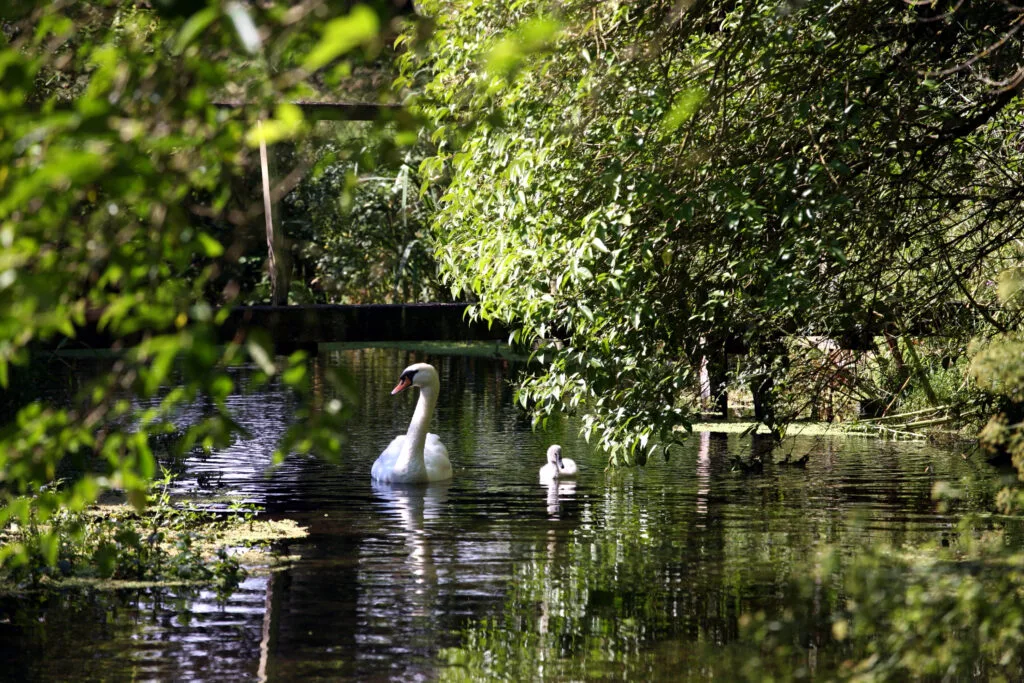
The River Test & Swans
The River Test is man made. Originally a swamp it was drained and modified by the Dutch, after they had finished their major work in the Fens. Henry V embarked his army, which was later to win the Battle of Agincourt in 1415, from a point 3 miles South of here, and it is said he sent all his heavy equipment down the river to Southampton, and so on to France for the campaign. The River Test was an important artery before the roads were improved. Later it became famous the world over for the quality of the trout fishing; and the oldest fishing club in the world, the Houghton Club, founded in 1822 still has its headquarters in Stockbridge nearby. The Test at Houghton has the best dry fly trout fishing in the world. In May and early June when the mayfly hatch, the river can be alive with feeding trout. From the end of the main lawn it is easy to imagine those early visitors strolling down to the river to cast a fly in the clear chalk stream, and seeing the same varieties of birds and animals living along the river as there are today, two hundred years later. Swans are indigenous to the River Test-we currently have approx 40 swans gracing our stretch of the river.
The Water Meadows
There are 15 acres of beautiful parkland and water meadows with a riverside walk through this conservation area, and site of natural beauty. The edges of the Water Meadows are a Site of Special Scientific interest, home to rare plants, and a rich insect life. Originally the water was encouraged to trickle over the grass from a carrier which was slightly higher, the water could be turned on in late winter to protect the grass from frost and deposit valuable nutrients. The water then trickled off into the river at a lower level. Store lambs (old season lambs will have been ‘stored’ over winter so farmers can supply the market before next year’s lambs are big enough.) could be fattened on this lush early pasture to obtain the best prices for the Easter market. This system, so lucrative for at least 150 years, was wiped out in the 1880’s with the arrival of frozen, mainly New Zealand, lamb. This very labour-intensive system became uneconomic about the same time as the sport of dry fly fishing evolved, and many of the ‘drowners’ found employment as river keepers and guides.
We have 3 Alpacas, and these were joined in 2020 by a small flock of Hebridean sheep. Alpacas often run with sheep and alert them to a predatory fox by spitting. Both species are ruminants and therefore make very good use of the somewhat coarse pasture in their field.
In 2024 we created a wildlife pond in association with the Houghton Environmental Group and the Wild Trout Trust. It is exciting to see many varieties of damsel and dragon flies colonising this new area.

Explore Our Gardens